How do you bring AI into your agency — not as a collection of bells and whistles, but as a fundamental shift in how work gets done? Not incremental improvement, but positioning for a 10× transformation.
Mid-sized brokerages are being squeezed from every direction:
- Private equity consolidators are rapidly rolling up competitors
- Carriers, still running on legacy infrastructure, are demanding cleaner, more structured submissions
- Institutional knowledge is trapped in aging producers
- Margins are tight, hiring is difficult, and the pressure to "do something with AI" is everywhere
Most AI efforts fail here because they misunderstand the constraints. The solution can't be a disjointed, one-off tool — it has to be holistic. It can't replace core systems overnight, but it has to work with them. And it isn't a turnkey rollout; it's more like changing the engine mid-flight.
To navigate this, we think about the stack in three deliberate layers: the model layer, the harness layer, and the brain layer.
Get these right, working together, and something powerful happens: the agency itself becomes queryable. More importantly, with a tight feedback loop, operational knowledge doesn't just get used — it compounds.
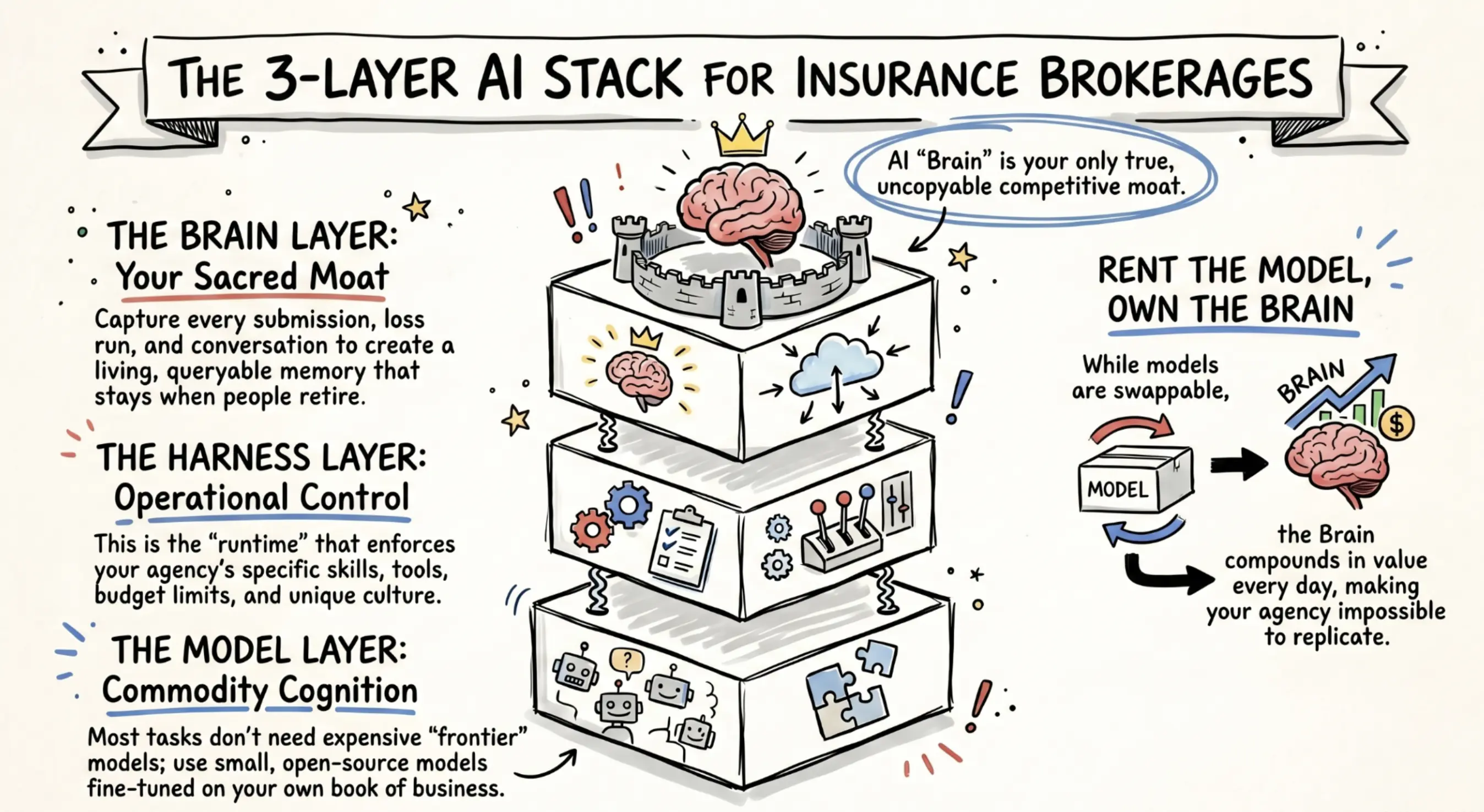
1 Model Layer
Generic intelligence, mostly commodity.
How to pick the model? It's a Type 2 decision — revisit it anytime. Pick one, mostly open source, and move on. For basic use cases — drafting a renewal letter, summarizing a loss run, extracting fields from an ACORD application, classifying an inbound carrier email, generating a certificate of insurance — the commodity models are more than sufficient. Reserve frontier models for the genuinely hard tail: complex coverage analysis, ambiguous claims advocacy, novel program design. Treat model selection as a routing decision, not a default.
The open-source path has a second advantage that proprietary APIs can't match: you can train it on your own book. Years of submissions, declinations, bound accounts, lost accounts, loss runs, claims notes, renewal narratives, and underwriter feedback are the brokerage's true differentiator.
The model is a dependency, not a moat. Pick the smallest one that does the job, and own the path to making it yours.
2 Harness Layer
Converting generic intelligence into virtual producers, account managers, and CSRs.
This layer takes the raw intelligence from the model and customizes it for your brokerage — wrapping everything about how you do the business, while keeping a clear eye on the cost to run the service. Four things the harness layer must accomplish:
Skills encode procedural knowledge
Skills are the "how we do it at this agency" packaged so an agent can execute them reliably: how we prep a submission for a manufacturing risk, how we write a renewal narrative for a $250K-premium account, how we issue a COI against a specific master policy. A skill is not a prompt — it's a versioned, testable, auditable procedure with inputs, steps, and acceptance criteria, especially security and privacy-focused guidelines, ideally co-authored with your best producers and senior account managers.
The library of skills is what compounds. It's the difference between an agent that can talk about insurance and one that can do the work of an account manager who has been on your team for ten years.
Tools: a curated, opinionated surface that fits your agency
Every agency is a snowflake. It has its own character and toolset: the AMS (Applied Epic, AMS360, EZLynx, HawkSoft), the document management system (ImageRight, Worksmart), carrier portals and rating platforms, certificate management, surplus lines filing, e-signature, the email and calendar stack, the phone system that records calls. But they use only 30% of the features to get their job done. The harness builds exactly that 30% — nothing more.
Encoded culture: making the agent behave like one of your producers
This is the hardest and most underrated part. The culture has to be encoded in system prompts, in skill definitions, in evaluation rubrics, in the human-in-the-loop checkpoints, in the feedback loop. The harness is where culture and compliance get enforced before any output reaches a client, a carrier, or a regulator.
Cost management: budgeting intelligence as a productivity input
Brokerages run on thinner margins than most SaaS companies. AI FinOps is the discipline of turning AI spend into measurable agency leverage. The goal is not to minimize the AI spend, but to maximize productivity per dollar. Done well, every dollar in the AI budget returns multiples in producer and AM output, and your hit ratio, retention, and account rounding all move with it. Done poorly, it's a SaaS line item with no defender at renewal time.
The model is rented; the harness is where you actually do the hiring.
3 Brain Layer
The accumulated, living record of how this agency thinks — and the defensible moat.
The model can be swapped. The harness can be rebuilt. The brain cannot. It is the accumulated, living record of how this agency thinks, places, services, and advocates — with every account's history, every carrier relationship, every loss conversation, every renewal narrative, every claim escalation — with the right permission management layering on top.
It is what makes agentic AI defensible rather than commoditized, and it is the asset the consolidator across town cannot replicate by writing a check. When the brain is healthy, the agency itself becomes queryable. A producer can ask: Which of my expiring accounts in the next 90 days haven't started renewal prep? Or: What's our current appetite at Hartford for restaurant risks in Texas?
Living memory, not a static knowledge base
The brain is not a wiki, not a SharePoint, not a one-time AMS export piped into embeddings. It is a continuously refreshed corpus that captures account history, coverage decisions and the reasoning behind them, carrier appetite and underwriter relationships, renewal narratives, lost-account post-mortems, claim outcomes, producer notes, and the why behind each. Institutional knowledge that used to walk out the door when a 30-year producer retired now stays. A coverage decision made on a Tuesday is queryable on Wednesday — with the carrier conversation, the producer's reasoning, and the client's reaction intact.
Curated ingestion
The brain is only as good as what feeds it. Producer and AM notes in the AMS, email threads with carriers and clients, recorded sales and service calls, submission packets, declinations, binders, endorsements, loss runs, claims correspondence, renewal questionnaires, expiration lists, certificate registers — the unstructured exhaust of the agency is the raw material. A serious brain layer has an ingestion pipeline that captures these sources, classifies them into the right buckets, deduplicates, links related items, and rejects noise. Garbage in, confidently wrong agent out.
Reinforcement loops: the brain compounds
Every interaction is a training signal. Everyone in the agency teaches the brain — no single point of failure, and every person feeds their knowledge and gives feedback. The brain learns which carriers fit which risks at your agency, which producers close which kinds of accounts, which renewal narratives correlate with retention. Over time, this produces a system that is genuinely better at your book of business than any external model could be — because it has lived through your placements.
This is the compounding curve that widens the moat rather than erodes it — the kind of compounding a roll-up cannot replicate by acquisition.
Evaluation: is the brain actually right?
A maintained brain has a maintained eval set: golden questions with known-good answers ("which carriers have we placed habitational risks with in the past 24 months and what was the average bound premium?"). It is, in this sense, a self-healing brain.
The stack, taken together
The three layers are not equal, and they are not optional. The model gives you cognition. The harness gives you control over cost, behavior, tools, and the E&O-grade discipline a regulated agency requires. The brain gives you continuity — the memory and judgment that turn a clever agent into a part of the agency.
Most brokerages today are over-investing in flashy point-solution AI tools, under-investing in a real harness, and barely thinking about the brain. The order should be reversed.
The model is rented. The harness is engineered. The brain is owned, curated, and defended — it is the only one of the three that gets more valuable every single day you operate.